Removing trade barriers key to boosting export growth of UK businesses
While barriers to trade affect most firms, overcoming recent EU challenges has led some to expand into new markets, a survey from the British Chambers of Commerce (BCC) and DHL Express has highlighted.
The survey of almost 1,000 UK businesses – 92% SMEs – shows almost half (48%) said the top barriers to exporting were costs and disruption, alongside tariffs (48%), and customs procedures (47%). A further 41% of businesses said regulatory issues such as product certification were a hindrance to trade, and 37% cited political, social, economic or environmental uncertainty.
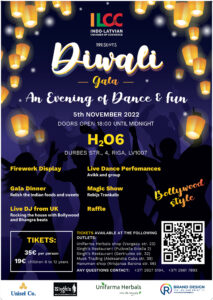
Our fellow Chamber is extending an invitation to their Diwali Gala!
Diwali Gala organised by Indo-Latvian Chamber of Commerce in support from Unisel Co, Unifarma, Singh’s Restaurants.
Come dressed in your groovy Indian Attire for an evening of Dance and fun on 5 November at H2O 6 kvartāls (Durbes iela 4, Riga) starting from 18:00. An evening with Fireworks display, Live DJ from UK rocking the house with Bollywood and Bhangra beats, Dance performances from Avikk and group, Magic show by renowned magician Robijs Trankalis, a gala dinner served on the night. An evening of celebrations, fun, games and Raffle.
Tickets are available at:
– Unifarma Herbal Shop (Vangazu Street 23);
– Singh’s Restaurant (Gertrudes str. 32);
– Singh’s Restaurant (Pulkveža brieža 2);
Autumn is traditionally perceived by market participants as a season of possible crises and amplified volatility. In September neither geopolitics nor central banks added stability to the markets, quite on the contrary, working hard to increase overall nervousness. The only good news in September was that the month finally ended. We saw currency pairs setting new records and interventions in forex market, yields skyrocketing and equity markets hitting new lows. Central banks were having busy days hiking interest rates, while market participants were keen to price in even more aggressive hikes by the end of the year. We expected US yield curve to become even more inverted and were right as short-term yields rose more than those of longer maturities, though in absolute terms all yields were rising stronger than we thought they would.
Baroness Martha Lane-Fox CBE elected President of the British Chambers of Commerce
Entrepreneur and business leader Baroness Martha Lane-Fox CBE has been elected the new President of the British Chambers of Commerce (BCC).
Baroness Lane-Fox was elected by representatives of the accredited Chamber Network at the BCC’s Annual General Meeting, today (Wednesday 12th October). She will take up the role, which is unremunerated, with immediate effect.
Baroness Lane-Fox will be succeeding Baroness Ruby McGregor-Smith CBE as President, whose two-year term came to an end in accordance with the BCC Articles of Association.
As President, Baroness Lane-Fox will work alongside BCC Chair Sarah Howard MBE and Director General Shevaun Haviland to represent the interests of Chamber business communities and trade in a crucial period for the UK.
Baroness Lane-Fox co-founded Europe’s largest travel and leisure website, lastminute.com in 1998. She is a passionate internet activist and was a Digital Champion for the UK from 2009-2013, helping to create the Government Digital Service. She is a director of Twitter and chair of WeTransfer, and she co-founded and chairs LuckyVoice, which has revolutionised the karaoke industry. She is the Chancellor of the Open University and was also made a crossbench peer in the House of Lords in 2013.
Welcoming Baroness Lane-Fox to the BCC, Chair Sarah Howard MBE said:
“Martha brings with her all the qualities that will make her an excellent President. She is creative, insightful, and has a wealth of knowledge that will be invaluable to our Chamber Network. She was one of the very first pioneers of the dotcom boom for businesses and has continued to pursue the internet and technology as a force for good throughout her inspiring and impactful career.
“I also wish to thank Ruby for her service to the BCC. She is a passionate advocate for business and has represented the BCC with energy and dedication during challenging times for UK businesses.”
The new BCC President, Baroness Lane-Fox said:
“I am very excited to be joining the BCC family and look forward to meeting with Chambers and hearing from businesses across the UK. Having founded and run my own businesses, I know first-hand the challenges firms are up against right now. Chambers provide invaluable support to ensure they can expand, invest and trade, and I look forward to helping British businesses thrive.”
“I am delighted to be handing over this fantastic role to such a strong and committed business advocate. Martha’s experience in the world of business is exceptional, and I know that she will do a brilliant job representing the BCC and the Chamber Network.
“It has been a real privilege to be the President of the British Chambers of Commerce. I wish the BCC and the Chamber Network every success in the future.”
RISEBA University Celebrates 30 Year Anniversary
BritCham would like to send our congratulationsandbest wishes to a long-standing member and cooperation partner of many events and projects – “RISEBA” University of Applied Sciences! May the 30th anniversary celebration be a very happy occasion and may there be many, many anniversaries yet to come!
Visit www.riseba.lv to learn more about RISEBA University.
Educational fair “Days of International Education” in Riga
Baltic Council Fairs – the leading in Europe study abroad events where thousands of schoolchildren, their parents, young people and students, teachers and professionals meet face-to-face with international education providers – universities, professional colleges, private and state schools, international language schools and camps and other educational institutions from all over the world. It is organized by the Baltic Council for International Education and supported by “Meridian Group” educational agency.
The upcoming fair in Riga will take place on October 15, 2022 at the Radisson Blu Hotel Latvija (address: 55, Elizabetes str.), 10.00 – 17.00
The Jackson Hole meeting involving top officials from the world’s biggest central banks has indicated their intention to follow through with the aggressive monetary stance to combat rising inflation. With large recession risks faced by both the EU and US in the nearest future, top bankers, for now, seem to choose short-term pain to economies and markets over inflationary damage. Naturally, market participants did not meet such stance with enthusiasm, with equities entering their 8th month of what now looks like a “decent” bear market. In the US, the S&P 500 fell by 4.2% with volatility index (VIX) rising to its highest level since mid-July. Similarly, we saw the European STOXX 600 down by more than 5%. Worsening labor market, below-trend growth and likely large rate increase in September suggest that the US market can forget about the “Fed put” (at least for now) and should prepare itself for a rainy autumn.
On 12 September every year we commemorate the brave Sikh soldiers who died at the Battle of Saragarhi. For details of these amazing people and their incredible bravery, please read the following.
BATTLE OF SARAGARHI
The Battle of Saragarhi was fought on 12 September 1897 between 21 Sikh soldiers of the British Indian Army and a force of Afridis and Orakzais Afghan tribesmen estimated to be between 6,000 – 10,000 strong. This was a part of the Tirah Campaign on the North-West frontier of what is now the Khyber Pass in Pakistan.
The Sikhs were led by Havildar Ishar Singh and they chose to fight to the death, in what is considered by some military historians as one of history’s greatest last stands, In so doing they killed an estimated 180 tribesmen before being totally annihilated. The post was recaptured two days later by another British Indian contingent.
Sikh military personnel commemorate the battle every year on 12 September, as Saragarhi Day.
ORDER OF MERIT
All the 21 Sikh non-commissioned officers and soldiers of other ranks who laid down their lives in the Battle of Saragarhi were from Majha region in Punjab and were posthumously awarded the Indian Order of Merit, the highest gallantry award of that time which an Indian soldier could receive. The corresponding gallantry award was the Victoria Cross. The award is equivalent to today’s Param Vir Chakra awarded by the President of India.
The names of the 21 recipients of the gallantry award are:
The Government of India have caused this tablet to be erected to the memory of the twenty one non-commissioned officers and men of the 36 Sikh Regiment of the Bengal Infantry whose names are engraved below as a perpetual record of the heroism shown by these gallant soldiers who died at their posts in the defence of the fort of Saragarhi, on the 12 September 1897, fighting against overwhelming numbers, thus proving their loyalty and devotion to their sovereign The Queen Empress of India and gloriously maintaining the reputation of the Sikhs for unflinching courage on the field of battle.
REMEMBRANCE AND LEGACY
The epic poem “Khalsa Bahadur” is in memory of the Sikhs who died at Saragarhi.
The battle has become iconic of eastern military civilisation, the British Empire‘s military history and Sikh history. The modern Sikh Regiment of the Indian Army continues to commemorate the Battle of Saragarhi on 12 September each year as the Regimental Battle Honours Day. To commemorate the men the British built two Saragarhi Gurudwaras[i]: one in Amritsar, very close to the main entrance of the Golden Temple, and another in Firozpur Cantonment, in the district from which most of the men hailed.
Saragarhi Day is a Sikh military commemoration day celebrated on 12 September every year to commemorate the Battle of Saragarhi. Sikh military personnel and civilians commemorate the battle around the world every year on 12 September. All units of the Sikh Regiment celebrate Saragarhi Day every year as the Regimental Battle Honours Day.
BritCham has been deeply saddened to learn of the news of the death today of Her Majesty Queen Elizabeth II. We send our sincere and heartfelt condolences to the Royal family.
The Queen will be greatly missed by the United Kingdom and the world.
BritCham Board
A Book of Condolence will be opened for signing at the British Embassy Riga, Jura Alunāna iela 5 between 14.30 – 16.30 starting Friday, 9 September to Friday, 16 September (except Saturday, 10 September and Sunday, 11 September).
Members of the public wishing to convey a personal message of condolence can also do so via an online Book of Condolence at https://www.royal.uk/.
Please visit https://www.royal.uk/ for updates from Buckingham Palace and to learn more about Her Majesty, the Queen’s life and reign.
How IT will transform e-commerce in 10 years
Arthur Gots, Chief Operational Officer at ECOMMPAY
The process of buying and selling goods and services has evolved significantly in the last decade or so, particularly with the growth of the internet. This has led to what we know as e-commerce, the main avenue for consumers to buy products, transmit data and transfer funds online. This evolution will only continue with greater technological advances and IT continuing to strengthen links between different aspects of financial markets. But what are IT’s current strengths and, although it is difficult to predict, how it is set to potentially transform e-commerce in the next decade?
How will IT technology strengthen the links between banks and e-commerce companies over the next decade?
It’s incredibly hard to see or predict this far in the future. For example, if we think back to 10 years ago, cryptocurrency was considered a geeky toy and nobody had heard about mobile payments like Apple Pay or Google Pay. What can be said for sure is that the line between traditional banks and e-commerce companies will continue to blur. With the help of IT technologies, it is already possible to create new products using classic banks as a base, a prime example being Vivid.
It is probable that technologies will push banks to implement more up-to-date methods as in the modern-day, consumers will expect improved services and user experience, therefore we can expect more technologies to improve faster. Along with this, the time to market for new banking/fintech products will decrease especially with the platform the internet provides.
It is enough to get the appropriate licence, create the outer wrapper, and get a technological platform and solutions from the partners/vendors. Of course, the majority of such companies won’t survive, but I believe that some of them can bring new ideas to the fintech market.
What role will IT play in how AI technology is further implemented into e-commerce solutions?
One of the most prominent roles IT plays in AI technology is through increasing fraud detection and prevention. By using adaptive technologies, companies are able to minimise losses due to the risks associated with illegal access to card data and are also able to improve the quality of ‘Know Your Customer'(KYC) checks.
With KYC services based on facial and image recognition technologies already existing, there is optimism for the future in terms of even further evolution and this is, therefore, a massive advantage for financial companies. For example, imagine KYC checks in a fully automated regime taking one minute as opposed to previously lasting for days or even weeks. Therefore its potential is unrivalled in both achieving enormous cost savings for companies and the possibility to provide services to clients that previously were unprofitable for business.
The other field for utilising data is data science. Based on historical data about the clients and data about their digital behaviours, fintech companies or banks can offer the most relevant products and solutions to each end consumer. For example, based on your geo activity, banks can provide a discount for your favourite cafe or restaurant when you pay with your payment card, providing a win-win-win situation for the bank, end-consumer, and cafe. The Bank increases turnover because you pay more frequently with the exact card, restaurants increase turnover because you spend more, and the end consumers enjoy the discount.
How will IT technology help evolve mobile e-commerce in the next 10 years?
Year by year, people are connecting more and more with their mobile phones and the possibilities they can provide. From viewing traffic jams on maps to contactless payments, the options tend to be endless and will only increase with greater technology. In a payment context, the share of contactless payment services using NFC, such as Apple Pay, is growing. This growth is also met with the evolution of services, money can now be withdrawn automatically from linked cards; particularly with both subscription and recurring payments.
Given all the previous and current developments, any further evolution in IT technologies for mobile payments would most likely be aimed at improving user experience where the process of paying for products and services will be as invisible to the consumer as possible. This would be achieved with the collection of a digital footprint of a person, developing frictionless payments based on users’ behavioural profiles; a considerable step in the implementation of 3D Secure 2.0.
Ten years in banking is a long time so no one can accurately predict where it will go. But one thing is certain – IT technology will only continue to play a significant role in the evolution of e-commerce.